SHANNON, CLARE, IRELAND, July 24, 2026 /EINPresswire.com/ —
Announcing a new publication from Opto-Electronic Advances; DOI 10.29026/oea.2026.250334.
In modern society, Cardiorespiratory rhythm disorders (CRD), including arrhythmia and sleep apnea, are quietly threatening the health of hundreds of millions of people worldwide. As a “silent killer” hidden in the human body, CRDs such as atrial fibrillation and premature ventricular contractions present almost no obvious symptoms in the early stage, without palpitations, dizziness, or other physical discomforts. These abnormalities only manifest as transient irregular heartbeats during nocturnal sleep. However, such seemingly subtle anomalies may implicitly increase the risk of stroke and heart failure. Clinical data show that more than 60% of patients with asymptomatic atrial fibrillation are only diagnosed after the onset of stroke, when the optimal treatment window has long been missed. Moreover, these hidden cardiopulmonary diseases continuously aggravate the social medical burden and expose numerous families to unexpected health crises.
Early detection is crucial to identify this “silent killer”. Nevertheless, traditional diagnostic methods, such as 24-hour Holter monitoring and laboratory-based polysomnography, are inadequate in practical scenarios. These approaches require long-term attachment of electrodes and are usually performed in hospitals only after symptoms appear, failing to meet the demands of early disease screening. Therefore, researchers have long been seeking a novel method that enables unobtrusive, accurate, and continuous health monitoring at home during sleep—the state in which the human body is most relaxed. Since human movement is limited and physiological indicators are relatively stable during sleep, it provides an ideal window for capturing subtle changes in cardiopulmonary signals and represents a critical breakthrough for the early detection of CRD.
In the development of health monitoring technologies, both wearable and non-wearable devices have inherent limitations. Wearable devices such as electrocardiography and photoplethysmography require direct skin contact, which may cause discomfort and often support only single-parameter detection. Non-wearable systems, including mattress pressure sensors and radar-based techniques, suffer from insufficient accuracy. Traditional fiber-optic non-contact monitoring schemes can only detect a single parameter and involve complex components that are difficult to integrate into home environments. Furthermore, monitoring systems combining sensors and artificial intelligence rely on “black-box” models and cannot reveal explicit pathological mechanisms.
As an emerging sensing technology, fiber-optic sensing converts physical variations such as pressure and strain into detectable optical signals. It offers unique advantages including electromagnetic interference resistance, high sensitivity, and flexible encapsulation, enabling non-contact capture of tiny pressure variations induced by human cardiopulmonary activities. This provides core technical support for home-based non-invasive monitoring and motivates researchers to explore novel monitoring schemes integrated with daily furniture, thereby achieving early, convenient, and accurate detection of CRD.
Recently, an interdisciplinary research team from Huazhong University of Science and Technology has proposed an ingenious solution to this challenge. By integrating fiber-optic sensing, biomechanical engineering, and advanced signal processing, this study achieves the first unobtrusive, non-invasive home-based nocturnal early detection of CRDs. It transforms passive sleep into an active clinical diagnostic process, opening a new avenue for home-oriented, data-driven personalized health management and precision preventive medicine.
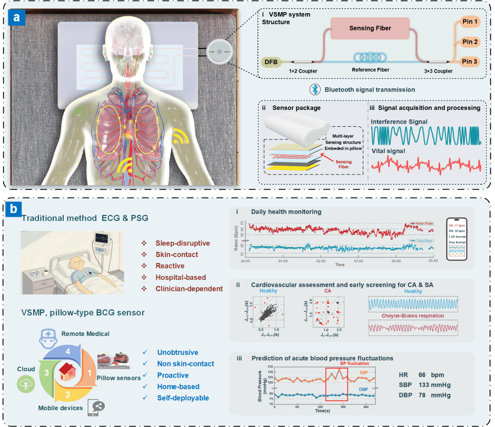
The monitoring pillow achieves multiple technological breakthroughs. The team embedded flexible fiber-optic sensors into a conventional pillow, encapsulated with multi-layer viscoelastic organic materials to enhance pressure sensitivity. Combined with a high-sensitivity fiber-optic interferometric structure, the pillow acts as a super-sensitive “stethoscope” that converts subtle pressure variations from the carotid artery into quantifiable optical signals. The system can be seamlessly integrated with home Fiber-to-the-Room (FTTR) infrastructure and supports single-terminal multi-user monitoring, effectively addressing the limitations of traditional monitoring methods, such as sleep disturbance and poor scalability.
In clinical validation, the vital sign monitoring pillow (VSMP) exhibits outstanding monitoring performance. The captured ballistocardiogram (BCG) signals show a high correlation coefficient of 0.984 with heart rate intervals from the clinical gold-standard electrocardiogram (ECG). The errors of key heart rate variability parameters, including SDNN and RMSSD, are less than 5% compared with ECG measurements. The system enables accurate pathological assessment of CRDs through HRV analysis and Lorenz scatter plots, successfully identifying pathological features in 20 CRD patients. It can also recognize abnormal respiratory patterns such as sleep apnea and Cheyne–Stokes respiration, realizing simultaneous cardiopulmonary monitoring. Furthermore, an AI-based blood pressure prediction model derived from BCG signals achieves continuous non-invasive blood pressure estimation with an error within 8%, allowing precise tracking of nocturnal blood pressure dynamics.
This technology features extensive application scenarios, including home nocturnal monitoring for middle-aged and elderly individuals at high cardiovascular risk, long-term physiological tracking for postoperative rehabilitation patients, and early cardiovascular risk screening for healthy populations. Integrated with telemedicine systems, it provides low-cost, high-precision monitoring solutions for elderly care facilities and primary medical institutions, facilitating the downward deployment of high-quality medical resources.
The development of this fiber-optic sensing intelligent pillow represents a significant achievement of interdisciplinary integration, driving the cross-application of fiber-optic sensing technology from industrial fields to civil health monitoring. With continuous technical optimization and industrialization, such smart home-integrated health monitoring devices will become increasingly prevalent. They are expected to build a comprehensive, unobtrusive home health monitoring network, making professional home-based health management a daily reality and promoting the development of preventive medicine toward personalization and precision.
Keywords: fiber-optic sensor, health monitoring, cardiorespiratory diseases, telemedicine, smart fiber, early disease screening
# # # # # #
Feng Wang is Deputy Chief Physician and Associate Professor in the Department of Cardiology, Tongji Hospital, Tongji Medical College, Huazhong University of Science and Technology. He currently serves as a member of the Atherosclerosis and Coronary Heart Disease Group of the 12th Chinese Society of Cardiology, Chinese Medical Association, a member of the Youth Working Group of the 6th Cardiologist Branch of Chinese Medical Doctor Association, and a member of the Extracorporeal Life Support Committee of Hubei Provincial Biomedical Engineering Society. He has received honors including the Excellent Communist Party Member awarded by the Hubei Provincial Health Commission and the May 4th Youth Medal of Tongji Hospital, Tongji Medical College, Huazhong University of Science and Technology. His research focuses on the mechanisms of RNA regulation in cardiovascular diseases such as hypertension, heart failure, coronary heart disease and cardiomyopathy. His team has presided over and participated in a number of national-level research projects, and has published a series of high-level papers in internationally renowned journals including Signal Transduct Target Ther, Circulation and Circ Res. Among them, his series of studies on Ago2 and cardiovascular diseases have achieved important breakthroughs, with 5 high-quality papers published in Circulation (2016, 2023), Circulation Research (2019), Signal Transduction and Targeted Therapy (2021) and Molecular Therapy (2024), and he has been granted a number of national invention patents.
Qizhen Sun is Professor and Vice Dean of the School of Optical and Electronic Information/Future Technology College, Huazhong University of Science and Technology, and Optica Fellow(formerly the Optical Society of America). She is engaged in the research on special fiber-optic sensing technology and its applications, serving as the Chief Scientist of the Key Research and Development Program of the Ministry of Science and Technology, and presiding over projects such as the National Natural Science Foundation of China (NSFC) for Distinguished Young Scholars, Excellent Young Scholars, and Regional Joint Key Projects; she also carries out cooperation with leading industry enterprises including Huawei, Hikvision, China National Petroleum Corporation and China National Offshore Oil Corporation . She has published more than 120 SCI papers in journals such as Light: Science and Applications, Nature Communications, Opto-Electronic Advances, PhotoniX, and Optica, holds 51 authorized invention patents and 4 software copyrights, participates in the formulation of 5 national standards/national military standards and 2 group standards, and has won 8 scientific and technological awards including the First Prize of Hubei Provincial Technological Invention, the First Prize of Technological Innovation of the Chinese Society of Optical Engineering, and the First Prize of Science and Technology of the China Communications Society. She has been dedicated to the front line of teaching in the optical field, won the Second Prize of National Teaching Achievement in Higher Education, and guided student teams to win 8 special prizes/gold prizes/first prizes in the three major national competitions including the “Internet +”, “Challenge Cup”, and “Creation Youth” competitions as well as the National Postgraduate Electronic Design Competition.
# # # # # #
Opto-Electronic Advances (OEA) is a high-impact, open access, peer reviewed SCI journal with an impact factor of 22.4 (Journal Citation Reports 2024). OEA has been indexed in SCI, EI, DOAJ, Scopus, CA and ICI databases, and expanded its Editorial Board to 41 members from 17 countries.
# # # # # #
More information: http://www.oejournal.org/oea
Editorial Board: http://www.oejournal.org/oea/editorialboard/list
All issues available in the online archive (http://www.oejournal.org/oea/archive).
Submissions to OEA may be made using ScholarOne (https://mc03.manuscriptcentral.com/oea).
ISSN: 2096-4579
CN: 51-1781/TN
Contact Us: oea@ioe.ac.cn
Twitter: @OptoElectronAdv (https://twitter.com/OptoElectronAdv?lang=en)
WeChat: OE_Journal
# # # # # #
Jin HY, Li H, Chen ZL et al. Unlocking home-based nocturnal health management: A fiber-optic approach for early detection of cardiorespiratory rhythm disorders. Opto-Electron Adv 9, 250334 (2026). DOI: 10.29026/oea.2026.250334
Opto-Electronic Advances Editorial Office
Opto-Electronic Advances
+86 591 2286 1222
email us here
Legal Disclaimer:
EIN Presswire provides this news content “as is” without warranty of any kind. We do not accept any responsibility or liability
for the accuracy, content, images, videos, licenses, completeness, legality, or reliability of the information contained in this
article. If you have any complaints or copyright issues related to this article, kindly contact the author above.

Media gallery