The Hackett Group, Inc. (NASDAQ: HCKT), a leading Gen AI consultancy and enterprise digital transformation firm, today released findings from its 2026 Supply Chain Key Issues Study, showing that supply chain leaders are accelerating artificial intelligence (AI) adoption as persistent cost pressure converges with the need to modernize. Momentum to deploy AI is concentrated in supply chain data visualization tools, intelligence and analytics, and advanced supply chain planning, where AI has become essential to faster, more informed decision-making and improved service performance in today’s volatile marketplace.
This press release features multimedia. View the full release here: https://www.businesswire.com/news/home/20260514642410/en/
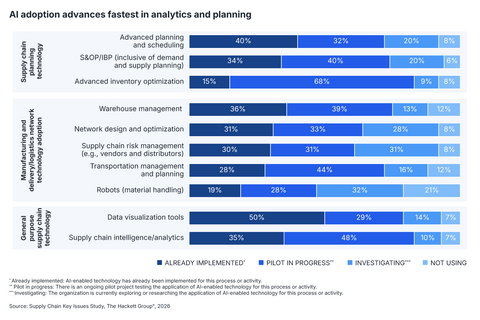
AI adoption in supply chain is shifting from experimentation to embedded capability, with momentum strongest in analytics and planning. Eighty-three percent of respondents are piloting or implementing AI in supply chain intelligence/analytics and 79% in data visualization. Importantly, these establish the data backbone for more advanced use cases. Planning adoption is also strong, with 74% of enterprises reporting AI capabilities have been implemented or piloted in S&OP/IBP and 72% in advanced planning and scheduling. In practice, that means shorter data analysis cycle time for planning activities and enhanced service cost trade-off decision-making. Advanced inventory optimization has the deepest pipeline of any use case, with only 15% of organizations having implemented AI capabilities but 68% piloting. The clear pattern is that AI scales fastest where it can be delivered through existing platforms and governed, rich datasets.
Cost-efficiency remains the top priority for supply chain leaders for the third consecutive year, reflecting ongoing geopolitical uncertainty, tariff exposure and inflationary pressures. At the same time, digital transformation has surged to the No. 2 priority from fifth place in 2025, underscoring the growing recognition that competitive advantage in the years ahead will be shaped not just by advanced technologies and AI, but also by the ability to deploy agentic workflows that sense, decide and act across the enterprise.
“Cost has been the top supply chain priority three years running – and that pressure is not easing,” said Kate Reilly, director, Strategy and Operations at The Hackett Group®. “What has changed is how leaders intend to respond. More organizations now recognize that cost improvement cannot be sustained without modernizing the platforms, data and processes that enable the supply chain.”
AI adoption is advancing most rapidly in analytics-intensive, data-rich areas of the supply chain. The study found that 83% of organizations have deployed or are piloting AI in supply chain intelligence and analytics, with 79% reporting data visualization capabilities. Supply chain planning is also a leading area of adoption, with 74% of enterprises reporting AI capabilities in sales and operations planning (S&OP) or integrated business planning (IBP), and 72% in advanced planning and scheduling. This shift is enabling speed to decisioning, as well as the ability to more precisely analyze cost, service and performance.
To support these gains, organizations are accelerating transformation across the supply chain. Network design optimization (67%) and increased transactional automation (66%) lead initiatives reported for 2026, followed by inventory optimization (59%) and core platform upgrades (57%). Together, these initiatives are reshaping supply chain operations to deliver greater efficiency and resilience at scale.
However, scaling AI remains dependent on addressing foundational challenges. Data quality (50%) and data integration (47%) continue to be the most significant concerns reported by supply chain leaders, along with data privacy and regulatory concerns (46%). At the same time, 45% of leaders cite a lack of AI talent as a major constraint, highlighting the need for targeted investment in talent and data readiness. Looking ahead, supply chain organizations are moving toward integrated, AI-enabled operating models that embed intelligence across supply chain activities.
“Supply chain leaders understand where they need to go next – toward more autonomous, AI-enabled workflows that improve planning, responsiveness and execution across the network,” said Erin Blair, principal, Strategy and Operations at The Hackett Group®. “What remains challenging is how to scale from individual use cases to a cohesive operating model that can support it. That gap between ambition and execution is becoming a competitive risk.”
As organizations balance immediate operational demands with longer-term transformation priorities, those that scale AI and modernize core supply chain capabilities will be best positioned to outperform on cost, resilience and service.
Read the 2026 Supply Chain Key Issues Study results.
About The Hackett Group®
The Hackett Group, Inc. (NASDAQ: HCKT) is an ROI-led, AI enterprise transformation firm that helps clients enable AI world-class performance. Its experts and engineers leverage proprietary AI delivery platforms – Hackett AI XPLR™, ZBrain™, XT™, AIXelerator™ and AskHackett™ – to accelerate and enhance the delivery of the company’s solutions and services.
The AI platforms are powered by the company’s domain-specific Hackett Solution Language Model informed by Hackett Process and Performance Intelligence – including Digital World Class® benchmark metrics, best practice process flows and service delivery model solution frameworks, which accelerate and enhance the delivery of its services. The Hackett Group’s proprietary insights are based on benchmarking results from leading global organizations, including 98% of Dow Jones Global Titans, 97% of the Dow Jones Industrials and 90% of the Fortune 100. Visit www.thehackettgroup.com
Trademarks
The Hackett Group®, quadrant logo, and Digital World Class® are the registered marks of The Hackett Group®.
Cautionary Statement Regarding “Forward-Looking” Statements
This release contains “forward-looking” statements within the meaning of Section 27A of the Securities Act of 1933 as amended and Section 21E of the Securities Exchange Act of 1934, as amended. Statements including without limitation, words such as “expects,” “anticipates,” “intends,” “plans,” “believes,” “seeks,” “estimates,” or other similar phrases or variations of such words or similar expressions indicating, present or future anticipated or expected occurrences or outcomes are intended to identify such forward-looking statements. Forward-looking statements are not statements of historical fact and involve known and unknown risks, uncertainties and other factors that may cause the Company’s actual results, performance or achievements to be materially different from the results, performance or achievements expressed or implied by the forward-looking statements. Factors that may impact such forward-looking statements include without limitation, the ability of The Hackett Group® to effectively market its digital transformation, our ability to transition our capabilities to support generative artificial intelligence (AI)-related consulting services and solutions and other consulting services, our ability to effectively integrate acquisitions into our operations, our ability to manage joint ventures and successfully cooperate with our joint venture partners, competition from other consulting and technology companies that may have or develop in the future, similar offerings, the commercial viability of The Hackett Group® and its services as well as other risk detailed in The Hackett Group’s reports filed with the United States Securities and Exchange Commission. The Hackett Group® does not undertake any duty to update this release or any forward-looking statements contained herein.
View source version on businesswire.com: https://www.businesswire.com/news/home/20260514642410/en/
Media gallery