Key Takeaways
- Women require a minimum force of 4.2 times their body weight to trigger meaningful bone growth, a threshold far exceeding what traditional exercises provide
- Walking generates forces typically ranging from 1 to 2.5 times body weight, depending on factors like speed and surface, while running produces forces typically ranging from 2 to 5 times body weight, leaving a critical gap for effective bone building that most women never address
- Specialized osteogenic loading systems, such as BioDensity, can safely deliver the high-impact forces needed through self-controlled resistance technology, significantly reducing injury risk compared to traditional high-impact activities
- Clinical evidence documents 7% hip and spine bone density improvements within one year using proper high-force loading techniques
- Post-menopausal women face accelerated bone loss that requires targeted interventions beyond conventional exercise recommendations
The quest for stronger bones has led countless women down disappointing paths filled with endless walks, light weights, and yoga sessions that feel productive but fail to deliver the bone-building impact their skeletal system actually needs. Behind the scenes at specialized bone fitness facilities, a different conversation is taking place—one focused on precise force measurements and the specific mechanical stress required to activate dormant bone cells. Health experts, like those at SPRY 365 in Dublin, OH, say that these focused conversations need to become more mainstream to make headway into the osteoporosis epidemic.
The Critical Force Gap: Why Your Exercise Isn’t Building Bone
The human skeleton operates on a deceptively simple principle: use it or lose it. But “using” bones means applying enough mechanical stress to trigger their adaptive response, and that threshold is surprisingly high. Most women remain completely unaware that their dedicated fitness routines fall dramatically short of what bones actually need to grow stronger.
The disconnect becomes clear when examining force measurements. A 140-pound woman needs nearly 590 pounds of force applied to her bones to trigger optimal adaptation—a number that sounds impossible through conventional exercise. This isn’t a marketing claim or fitness trend; it’s rooted in decades of bone physiology research that most fitness professionals never encounter in their training.
Understanding this force gap explains why so many active women still develop osteoporosis despite maintaining consistent workout routines. The missing piece isn’t effort, consistency, or even genetics in most cases—it’s the specific type and intensity of mechanical loading that bones require for meaningful growth.
Research Shows High Force Thresholds for Meaningful Bone Growth
Multiple Studies Point to 3-4x Body Weight Minimum
Scientific research in osteogenic loading has established clear force requirements for bone adaptation, with multiple studies converging on similar thresholds. A pivotal 2012 UK study by Deere and Tobias determined that a minimum force of 4.2 times body weight is required to activate osteoblasts—the cells responsible for bone growth—particularly in the critical hip joint, where fractures can be devastating.
These findings aren’t isolated results but part of a larger body of research examining bone mechanobiology. Studies consistently show that forces below 3-4 times body weight fail to generate the cellular signaling necessary for meaningful bone adaptation. The 4.2x threshold represents the minimum effective dose for bone growth, similar to how medications require specific concentrations to produce therapeutic effects.
How Wolff’s Law Explains Bone Adaptation
Wolff’s Law, developed by Julius Wolff in the 19th century, describes how bones adapt their structure in response to mechanical demands. This fundamental principle operates through mechanosensitive cells called osteocytes that detect mechanical strain and initiate cellular responses signaling osteoblasts to build new bone tissue. When bones experience sufficient loading above the 4.2x threshold, they interpret the stress as a signal to strengthen and add new mineral deposits.
The law explains why astronauts lose bone density in zero gravity and why tennis players develop thicker, stronger bones in their dominant arm. For post-menopausal women, mechanical loading becomes even more critical as estrogen decline disrupts the natural balance between bone formation and breakdown, making exercise-induced bone stress the primary stimulus for maintaining density.
Traditional Workouts Fall Short of Bone-Building Requirements
Walking Generates Forces Typically Ranging from 1 to 2.5 Times Body Weight
Walking, often touted as the gold standard for bone health, generates forces typically ranging from 1 to 2.5 times body weight, depending on factors like speed and surface—less than half what bones need for growth stimulation. Even enthusiastic daily walks covering several miles fall significantly short of the osteogenic threshold. The cardiovascular benefits are undeniable, but the bone-building impact remains minimal regardless of duration or frequency.
This limitation becomes more pronounced for women who prefer gentler activities like swimming or cycling, which generate even lower bone-loading forces despite their other health benefits. These activities excel at maintaining cardiovascular fitness and joint mobility but cannot address the specific mechanical requirements for bone density improvement.
Running Produces Forces Typically Ranging from 2 to 5 Times Body Weight
Running improves the force equation considerably, with heel strikes potentially reaching 3-4 times body weight and higher forces possible at increased speeds or for certain running styles, but still doesn’t consistently achieve the 4.2x minimum needed for optimal bone adaptation. The force generation varies significantly based on pace, stride length, and running surface, with only high-intensity sprinting or downhill running approaches potentially reaching therapeutic thresholds.
However, these higher-impact running activities carry substantial injury risks, particularly for women over 40 whose joints may not tolerate repeated high-impact forces. The irony becomes clear: the running intensities needed for bone building often exceed what’s safe for other body systems, creating a problematic risk-benefit equation.
Light Weight Training Provides Limited Bone Stress
Traditional resistance training with light to moderate weights rarely generates the high forces required for bone growth. A typical bicep curl with 10-pound dumbbells or leg extensions with 30 pounds create muscle fatigue without approaching the mechanical stress bones need for adaptation. Even progressive weight training, while beneficial for muscle development, rarely reaches the force intensities required for significant bone density improvements.
The challenge lies in safety limitations of conventional weight training. Achieving 4.2x body weight forces through traditional lifting would require moving extremely heavy loads that exceed most people’s strength capabilities and dramatically increase injury risk. This creates a frustrating paradox: bones need high forces to grow, but conventional exercise methods can’t safely deliver them.
BioDensity Technology Safely Delivers High-Force Loading
Self-Controlled Resistance Significantly Reduces Injury Risk
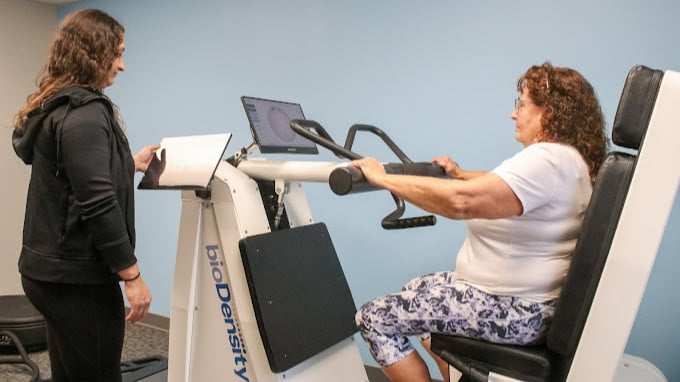
BioDensity systems solve the force-safety paradox through self-controlled resistance technology that allows users to generate extremely high forces. While individuals with pre-existing conditions should exercise caution, this approach significantly reduces injury risk compared to traditional high-impact activities. The system uses pneumatic and hydraulic mechanisms that respond to the user’s own force output, making it impossible to exceed strength capabilities or lose control of the resistance.
During a BioDensity session, users engage resistance in four key positions targeting the spine, hips, and upper body. The machine provides real-time feedback showing exactly how much force they’re generating, often revealing that people can produce forces well above the osteogenic threshold, sometimes exceeding 8 to 12 multiples of body weight, when positioned in optimal biomechanical alignments. This controlled environment eliminates the coordination, balance, and technique requirements that limit force production in traditional weight training.
Precise Force Measurements Track Progress
Unlike traditional workouts where progress assessment can be subjective, BioDensity provides exact measurements of force output for each exercise position. This data tracking reveals strength improvements session by session. BioDensity training has been shown to lead to significant increases in force production, with some users experiencing gains of over 100% in several months to years, as the neuromuscular system adapts to high-intensity loading protocols.
The precision measurements also allow for systematic progression and plateau identification. Users can see exactly when they’ve reached new force thresholds and track their consistency in achieving bone-building intensities. This objective feedback proves particularly valuable for post-menopausal women who may doubt their physical capabilities or worry about injury risks.
Clinical Evidence Shows Dramatic Bone Density Improvements
7% Hip and Spine Gains Within One Year
Clinical research on osteogenic loading has documented remarkable bone density improvements that exceed what’s typically achieved through traditional exercise or even some medications. Multiple studies and documented DEXA scan results show individuals experiencing 7-8% improvements in hip and spine bone density within just one year of consistent osteogenic loading protocols.
These improvements represent significant progress considering that untreated post-menopausal women typically lose 1-5% of bone density annually, particularly in the initial years following menopause. The documented gains of 7% hip density and 7.7% spine improvements in research participants demonstrate the potential for not just halting bone loss but actively rebuilding skeletal strength. Clinical evidence and testimonials suggest the potential for significant bone density improvements, with some individuals, including a 76-year-old woman with diagnosed osteoporosis, reportedly reversing their condition after one year of BioDensity training.
Post-Menopausal Women Benefit from Targeted Intervention
Research involving post-menopausal women has consistently demonstrated the effectiveness of high-force loading interventions. The hormonal changes accompanying menopause create an accelerated bone loss environment where traditional exercise recommendations prove insufficient. However, when adequate force thresholds are achieved through specialized equipment, post-menopausal women show remarkable bone density recovery rates.
Long-term tracking has documented bone density improvements in committed users, with some individuals experiencing T-score improvements and progress towards healthier bone density ranges. These improvements often translate to reduced fracture risk and increased confidence in daily activities, addressing both the physical and psychological impacts of bone density concerns.
Age 30+ Requires Increased Bone Health Awareness and Action
Estrogen Decline Accelerates Bone Loss After Menopause
Estrogen decline after menopause disrupts the delicate balance between bone formation and bone breakdown, accelerating bone loss to typically 1-5% annually. This hormonal shift makes mechanical loading even more critical for post-menopausal women, as exercise-induced bone stress becomes the primary stimulus for maintaining bone density in the absence of protective estrogen levels.
The transition period around menopause represents a particularly vulnerable time when proactive intervention can prevent the steep bone density declines that follow. Women who begin targeted bone-building protocols during perimenopause often maintain or even improve their bone density through menopause and beyond, avoiding the dramatic losses experienced by those relying solely on conventional exercise recommendations.
Early Intervention Prevents Steep Density Declines
Bone density naturally begins declining after age 30, but the process accelerates significantly after age 40, particularly for women approaching menopause. This timeline creates a critical window for intervention where proactive bone-building strategies can prevent the steep declines that occur later. The earlier high-force loading begins, the better the long-term outcomes, though research demonstrates benefits even for women beginning protocols in their 60s, 70s, and 80s.
The key lies in understanding that bone adaptation is a slow process requiring patience and consistency. While strength improvements appear within weeks of beginning osteogenic loading protocols, bone density changes typically become measurable through DEXA scans after 6-12 months of consistent training. This delayed timeline reflects the natural bone remodeling cycle where old tissue is gradually replaced with new, denser bone matrix.
Choose Evidence-Based Approaches To Increase Bone Density
The types of exercise women over the age of 40 typically choose have pronounced cardiovascular benefits, the experts at SPRY 365 say, but lack the necessary force to build bone. Effective bone building requires more than just applying force—it demands the right type of force, applied at optimal frequency, with proper progression and safety protocols.
By focusing on the specific physiological requirements for bone adaptation rather than generic fitness recommendations, women can not only halt bone loss, but also actively rebuild stronger, more resilient skeletal systems regardless of their starting point. It’s never too late to start, but bone loss progresses with each passing day. Make an investment in your skeletal health today.
SPRY 365
+1 614 594 8510
5995 Wilcox Pl Suite E
Dublin
OH
43016
United States